A patient who cannot breathe comfortably will not present a neat checklist. They may be frightened, unable to answer questions, and deteriorating while family members watch. EMT psychomotor skills prepare you to bring order to that moment: assess the patient, identify immediate threats, communicate clearly, and perform the appropriate intervention without losing sight of the whole person.
For new EMT students, practical skills can feel intimidating because they are visible. An instructor can see how you position yourself, whether you reassess after treatment, and how you speak to a patient. That visibility is valuable. It turns practice into feedback, and feedback into habits that carry from the classroom to the ambulance, emergency department, or public-safety role you pursue.
What EMT Psychomotor Skills Actually Measure
Psychomotor skills are the hands-on patient-care tasks an EMT must be able to perform safely and in the correct sequence. But the word “hands-on” can be misleading. Strong performance is not simply about remembering where to place a blood pressure cuff or how to assemble oxygen equipment. It is about combining technical actions with clinical judgment, scene awareness, and professional communication.
During a practical evaluation, an examiner is looking for evidence that you can manage priorities. Did you address hazards and use appropriate personal protective equipment? Did you form a general impression and recognize a life threat? Did you assess airway, breathing, and circulation before becoming absorbed in a less urgent detail? Did you explain what you were doing and protect the patient’s dignity?
The specific format of skills testing and certification requirements can change with New York State EMS policy and course standards. Students should always follow the current directions provided by their approved training program and exam process. The underlying expectation remains consistent: an EMT must deliver organized, safe, patient-centered care under pressure.
The Core Skills Behind a Strong Practical Performance
Individual stations may focus on a particular patient presentation or procedure, but they are connected by the same disciplined approach. A student who treats every scenario as a separate script often struggles when the situation changes. A student who understands the patient assessment process can adapt.
Four areas deserve repeated practice:
- Scene size-up and primary assessment: recognizing hazards, determining the need for additional resources, forming an initial impression, and finding immediate airway, breathing, or circulation problems.
- Medical and trauma assessment: gathering a focused history, performing an appropriate exam, identifying relevant signs and symptoms, and reassessing when the patient’s condition or treatment calls for it.
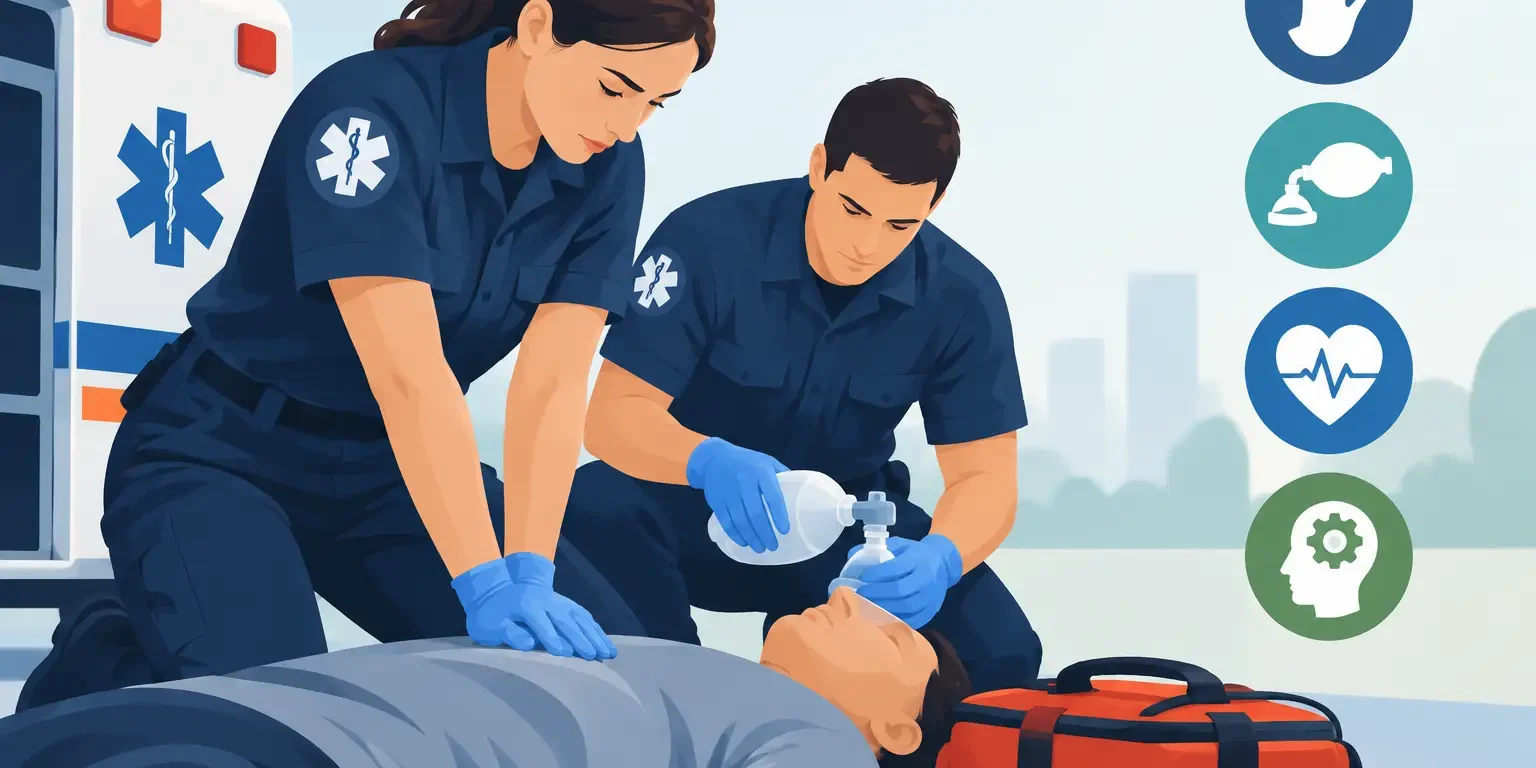
- Airway and breathing management: opening and maintaining an airway, selecting oxygen or ventilation support appropriately, and confirming that the intervention is helping.
- Trauma care and movement: controlling severe bleeding, managing suspected shock, protecting the spine when indicated, and moving or immobilizing patients with attention to safety and teamwork.
These categories overlap in real calls. A trauma patient may need airway support before a detailed physical exam. A medical patient with chest discomfort may become unstable while you obtain a history. The skill is not reciting every possible step. The skill is recognizing what must happen now, what can wait briefly, and what must be communicated to your partner and receiving facility.
Patient Assessment Is the Framework
Many practical errors begin when students view patient assessment as a memorization exercise. They rush through questions because they want to reach the intervention, or they complete an intervention and fail to reassess its effect. In the field, neither approach serves the patient.
Assessment gives meaning to every action. If a patient is short of breath, you need more than a complaint. You need to observe work of breathing, listen when appropriate, obtain vital signs, consider relevant history, and determine whether the patient is improving, stable, or worsening. Your findings guide your treatment and the urgency of transport.
Practice saying your assessment aloud in a clear, professional voice. In a testing environment, verbalizing key observations helps demonstrate your decision-making. In the field, concise communication keeps your partner informed and prepares you to give an organized report. The goal is not to narrate every thought. It is to communicate the information that affects care.
Procedures Need Purpose, Not Just Precision
Technical precision matters. Equipment must be selected, assembled, and used correctly. Safety precautions cannot be skipped. Yet a procedure performed perfectly at the wrong time, or without reassessment, is not strong EMT care.
Consider bleeding control. The procedure may require direct pressure, wound packing, a tourniquet, or another intervention based on the situation and current protocol. The larger skill is recognizing serious hemorrhage quickly, acting decisively, checking whether bleeding is controlled, and treating for shock while preparing for transport. The procedure and the patient assessment work together.
This is why practice should include decision points. Ask yourself: What did I find? What is my immediate concern? What treatment is indicated within my scope and local protocol? What result should I expect? What will I do if the patient does not improve? Those questions build clinical reasoning before the stress of a practical examination or real response call.
How to Practice EMT Psychomotor Skills Effectively
Repetition is necessary, but unfocused repetition can reinforce weak habits. A better approach is deliberate practice: perform a skill, receive specific feedback, correct one or two issues, and perform it again. Students often improve more from three attentive repetitions than from ten rushed ones.
Start slowly enough to understand the sequence. Accuracy comes before speed. Once the order of operations is solid, add realistic pressure by practicing with a partner, a time limit, an evolving patient condition, or distracting scene information. You should be able to pause long enough to think without becoming frozen when something unexpected occurs.
It also helps to separate your practice into two levels. First, practice the mechanics of a procedure until handling equipment feels familiar. Then practice the procedure inside a full scenario. This prevents a common problem: students can demonstrate a task alone but struggle to decide when to use it while assessing a patient.
Use feedback productively. If an instructor tells you that you missed a safety step, failed to reassess, or gave an unclear handoff, do not treat that as a judgment on your potential. Treat it as a specific correction. EMS professionals continue receiving feedback throughout their careers because patient care is a team responsibility.
At TIMER, students learn with instructors whose experience includes EMS, hospital care, nursing, and emergency response. That field perspective matters because instructors can explain not only the expected sequence, but also why a decision matters when the patient, family, environment, and transport plan are all demanding attention.
Common Mistakes That Cost Students Points and Confidence
The most frequent practical-test mistakes are rarely dramatic. They are small omissions caused by stress: forgetting personal protective equipment, skipping scene safety, failing to request appropriate resources, or moving into a detailed exam before managing an immediate life threat.
Another common issue is tunnel vision. A student identifies one problem and stops looking for others. For example, oxygen may be appropriate for a patient based on assessment and protocol, but oxygen alone does not replace a complete evaluation, ongoing vital signs, or transport planning. The patient must be reassessed after interventions.
Communication can also affect performance. Speak directly to the patient whenever possible, even when working with a manikin. Explain procedures, ask consent when appropriate, and use calm language. Then communicate your findings and plan to your partner in a concise way. Professional communication shows that you understand the patient is more than a scenario.
Finally, avoid treating a missed step as a reason to give up. If you recognize an omission, correct it when it is still appropriate to do so and continue caring for the patient. A practical evaluation measures your ability to recover, prioritize, and remain focused as well as your ability to remember a sequence.
Turning Classroom Practice Into Career Readiness
Certification preparation is a major milestone, but psychomotor training has a longer purpose. The habits you develop while practicing assessments, airway management, bleeding control, patient movement, and communication become the foundation of dependable field performance. They also transfer to future work in firefighting, hospital care, nursing, law enforcement support roles, and other healthcare careers.
The EMT who earns trust is not the person who looks busiest. It is the person who stays organized, treats patients with respect, recognizes urgent problems, and works well with others. Those qualities are built one scenario at a time.
Approach every skills lab as a chance to become calmer, more capable, and more useful to the people who will call for help on their hardest day. Bring your questions, accept correction, and practice until safe patient care feels less like a test and more like your professional standard.