A trauma call rarely arrives with a complete story. A fall may involve anticoagulants, a minor-looking crash may hide major internal injury, and a patient who is talking clearly can deteriorate during transport. Learning how to assess trauma patients means building a disciplined process that finds immediate threats first, gathers meaningful information quickly, and does not let distractions pull attention away from the priorities.
For EMT students and working providers, the assessment is not a script to recite. It is a decision-making framework. Your findings guide treatment within your scope, determine the urgency of transport, and give the receiving team the information they need to continue care without delay.
Begin Before You Touch the Patient
A reliable trauma assessment starts with scene size-up. Before entering, consider whether the scene is safe for your crew, the patient, and bystanders. Traffic, violence, unstable structures, downed wires, hazardous materials, and an active fire scene can turn one patient into several. Use appropriate personal protective equipment and request additional resources early when the situation calls for them.
Next, look at the mechanism of injury. The mechanism does not diagnose an injury, but it helps you anticipate where serious problems may be hiding. A high-speed collision, vehicle ejection, fall from a significant height, penetrating injury, blast exposure, or crush event deserves a high index of suspicion even when visible injuries appear limited.
Take in the whole scene. How many patients are there? Is there evidence of significant force, such as major vehicle intrusion, broken glass, a damaged helmet, or a long fall distance? Do you need fire, police, rescue, ALS, or additional ambulances? These early decisions protect the patient from delays later in the call.
How to Assess Trauma Patients With a Primary Survey
The primary survey is your search for immediate life threats. It should be organized, purposeful, and repeated whenever the patient’s condition changes. Follow your New York State protocols, medical direction, and local agency procedures, but the central goal remains the same: identify and manage problems that can kill the patient within minutes.
Form a general impression
As you approach, note the patient’s position, level of distress, skin color, work of breathing, and obvious bleeding. Are they alert and speaking? Are they pale, sweaty, confused, or unable to stay awake? A general impression can quickly tell you whether this is a load-and-go patient or whether there may be time for a more detailed on-scene evaluation.
Assess responsiveness using an organized method such as AVPU: alert, responsive to verbal stimuli, responsive to painful stimuli, or unresponsive. If the patient can answer, listen closely. Their ability to speak in full sentences offers useful information about airway status, breathing, and mental status.
Control life-threatening bleeding first
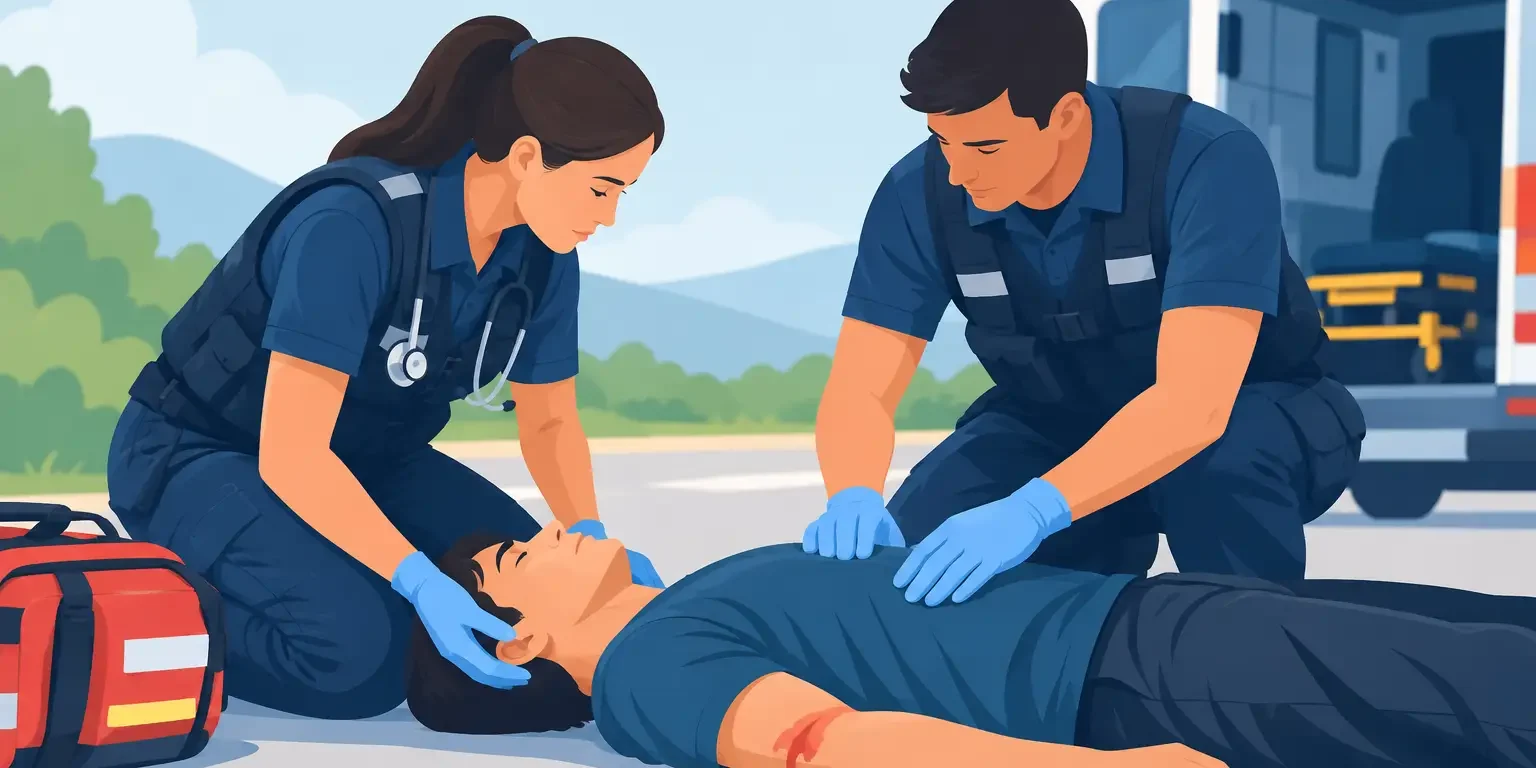
Severe external hemorrhage can become fatal quickly. Look for blood pooling on the ground, clothing soaked through with blood, spurting bleeding, or a partial or complete amputation. Control major bleeding using the equipment and techniques authorized by your protocols, such as direct pressure, wound packing, pressure dressings, or a tourniquet.
Do not allow a dramatic fracture or a visibly painful injury to pull your attention from uncontrolled hemorrhage. A deformity can wait briefly. Critical bleeding cannot.
Manage airway and consider spinal motion restriction
Determine whether the airway is open and maintainable. Listen for snoring, gurgling, stridor, or other abnormal sounds. Vomiting, blood, facial trauma, burns, and altered mental status can all threaten airway patency. Use basic airway maneuvers, suction, and airway adjuncts when indicated and within your scope.
Trauma patients may also require spinal motion restriction. This is not an automatic response to every complaint of neck or back pain. Consider the mechanism, neurologic findings, distracting injuries, level of consciousness, and patient complaints. Follow current protocol guidance and use a patient-centered approach. The objective is to reduce unnecessary movement while still addressing more urgent problems such as airway compromise or bleeding.
Evaluate breathing and circulation
Expose the chest as needed to assess breathing. Look, listen, and feel for rate, effort, chest rise, unequal movement, wounds, bruising, and signs of respiratory distress. Provide oxygenation or ventilation support when indicated by the patient’s condition and local protocol. A patient with inadequate respirations needs assisted ventilation, not simply an oxygen mask.
Then assess circulation. Check pulse quality, skin signs, and evidence of shock. In trauma, shock may be caused by bleeding that cannot be seen. A cool, clammy patient with a weak pulse, increasing anxiety, or altered mental status may be losing blood internally even if there is little external bleeding. Keep the patient warm, manage treatable causes within your scope, and prioritize rapid transport when shock is suspected.
Check neurologic status and expose strategically
Assess pupils, movement, sensation, and mental status as appropriate. A declining level of consciousness after trauma should be treated seriously, especially when head injury, hypoxia, or shock may be involved.
Expose enough of the patient to find injuries, but protect privacy and prevent heat loss. Trauma patients can become cold quickly, and hypothermia can worsen outcomes, particularly when bleeding is present. Cover the patient once your assessment is complete and continue to monitor skin temperature and overall condition.
Decide Whether the Patient Needs Rapid Transport
The scene is not the place for a lengthy assessment when the patient has compromised airway, breathing, circulation, altered mental status, signs of shock, significant burns, penetrating trauma to the head, neck, chest, abdomen, or groin, or a concerning mechanism with abnormal findings.
Transport decisions depend on more than one finding. A stable patient with an isolated extremity injury may allow time for a detailed assessment and focused treatment. A patient with multiple injuries, worsening vital signs, or evidence of internal injury may require immediate movement to the ambulance and early notification to the appropriate receiving facility.
When in doubt, use your protocols, consult medical direction when available, and consider the trajectory of the patient rather than a single set of vital signs. Trauma can evolve quickly. A patient who appears stable at first contact may not remain stable 10 minutes later.
Complete the Secondary Assessment Without Losing Focus
Once immediate threats have been addressed and transport is underway or the patient is stable enough for further assessment, complete the secondary survey. This includes a focused history, a detailed physical examination, and baseline vital signs.
For a responsive patient, use SAMPLE history: signs and symptoms, allergies, medications, pertinent medical history, last oral intake, and events leading to the injury. Medications matter. Blood thinners, insulin, seizure medications, and cardiac drugs can change how you interpret the patient’s presentation and risk.
Ask where it hurts, what feels different, whether there was loss of consciousness, and whether the patient has numbness, weakness, dizziness, nausea, or trouble breathing. Do not assume that a patient who minimizes pain has minor injuries. Some patients are frightened, distracted, or determined not to inconvenience anyone.
Perform a systematic head-to-toe examination when the mechanism or patient condition warrants it. Look and feel for tenderness, deformity, bruising, swelling, wounds, instability, or abnormal movement. Assess the head and face, neck, chest, abdomen, pelvis, extremities, and back as safely as circumstances allow. Check circulation, sensation, and movement distal to injured extremities before and after splinting.
A focused exam may be more appropriate for a clearly isolated injury. For example, a patient who tripped, is alert, has no concerning mechanism, and has isolated ankle pain may not need the same examination as a patient involved in a rollover collision. Good assessment is not about doing more steps. It is about choosing the right steps for the patient in front of you.
Reassess, Document, and Communicate
Reassessment is where strong EMT practice separates a one-time checklist from active patient care. Repeat the primary survey after any intervention, after movement, and whenever the patient’s condition changes. Recheck vital signs at intervals appropriate to the patient’s acuity. Trend changes in mental status, pulse, respiratory effort, skin signs, pain, and oxygenation when available.
Your handoff should give the receiving team a clear picture: mechanism of injury, initial presentation, key primary survey findings, treatments provided, response to treatment, vital-sign trends, relevant medical history, and estimated time of injury. Clear communication prevents valuable details from being lost between the street and the emergency department.
Documentation should be equally specific. Record what you found, what you did, when you did it, and how the patient responded. Avoid vague phrases such as “patient stable” without supporting findings. A useful report shows the patient’s condition over time.
Trauma assessment becomes more confident through repetition, scenario practice, and honest review of your decisions. At TIMER, students build these habits through practical instruction that connects certification skills with the realities of field care. The goal is not to look busy at a trauma scene. It is to stay calm, recognize danger early, and give every patient a careful, professional start to emergency care.