A bystander’s first aid decisions can shape the next several minutes of an emergency. A calm response may control life-threatening bleeding, start CPR, bring an AED to a person in cardiac arrest, or give a sick or injured person the reassurance to stay still until help arrives. The goal is not to diagnose every condition. It is to recognize immediate danger, work within your training, and get the right help moving quickly.
For people considering EMT school, healthcare work, firefighting, or public safety, first aid is often an early lesson in what emergency care really demands: attention to detail, clear communication, physical skills, and sound judgment under pressure. Those habits are valuable long before a student enters an ambulance or sits for a New York State certification examination.
First Aid Starts With Scene Safety
The first patient is never the only concern. Traffic, fire, unstable structures, violence, hazardous materials, downed wires, and even an agitated crowd can turn a rescue attempt into a second emergency. Before approaching, pause long enough to look for threats and decide whether the area is safe.
If it is not safe, do not enter simply because someone needs help. Call 911, provide a clear location and description of the hazard, and follow dispatcher instructions. A responder who becomes injured cannot assist the original patient.
When the scene appears safe, use available protective equipment. Gloves are a practical starting point when contact with blood or body fluids is possible. If gloves are unavailable, avoid direct contact where you can and wash exposed skin as soon as practical. Professional responders learn to make these choices routinely, but the same mindset belongs in community first aid.
A Practical First Aid Order of Operations
Emergencies are confusing because several problems may compete for attention. A simple sequence prevents a responder from focusing on a minor injury while missing an immediate threat to life.
- Check the scene and use protection. Look for danger, identify the number of patients, and use gloves or other barriers if available.
- Get help early. Call 911 or direct a specific person to call. If an AED is nearby, send someone to retrieve it.
- Check responsiveness and breathing. Speak to the person, tap their shoulder if appropriate, and look for normal breathing. Gasping or irregular breathing is not normal breathing.
- Address immediate life threats. Begin CPR and use an AED for a person who is unresponsive and not breathing normally. Apply firm direct pressure for severe external bleeding.
- Stay, observe, and communicate. Keep the patient as comfortable as possible, monitor changes, and provide concise information when EMS arrives.
This sequence is deliberately straightforward. It does not replace hands-on training, and specific circumstances can change what comes next. A person with suspected opioid overdose, for example, may need rescue breathing, naloxone if it is available and the responder is trained to use it, and immediate activation of 911. A person with chest discomfort who is awake and talking still needs urgent evaluation, even if symptoms seem to improve.
Calling 911 Is an Active Part of Care
Calling for help is not a sign that a responder has done too little. It is one of the most useful actions available. Give the dispatcher the exact address or a clear landmark, what happened, the patient’s approximate age if known, and whether the person is awake and breathing normally. Keep the line open unless told otherwise.
If other people are present, assign tasks directly. “You in the blue jacket, call 911.” “Please bring the AED from the lobby.” Specific directions work better than asking a crowd whether someone can help. They also reduce the chance that everyone assumes another person has already called.
The Skills That Matter Most
Many first aid classes cover a wide range of injuries and illnesses. The highest-value skills are often the ones that address the conditions where minutes matter most.
CPR and AED Use
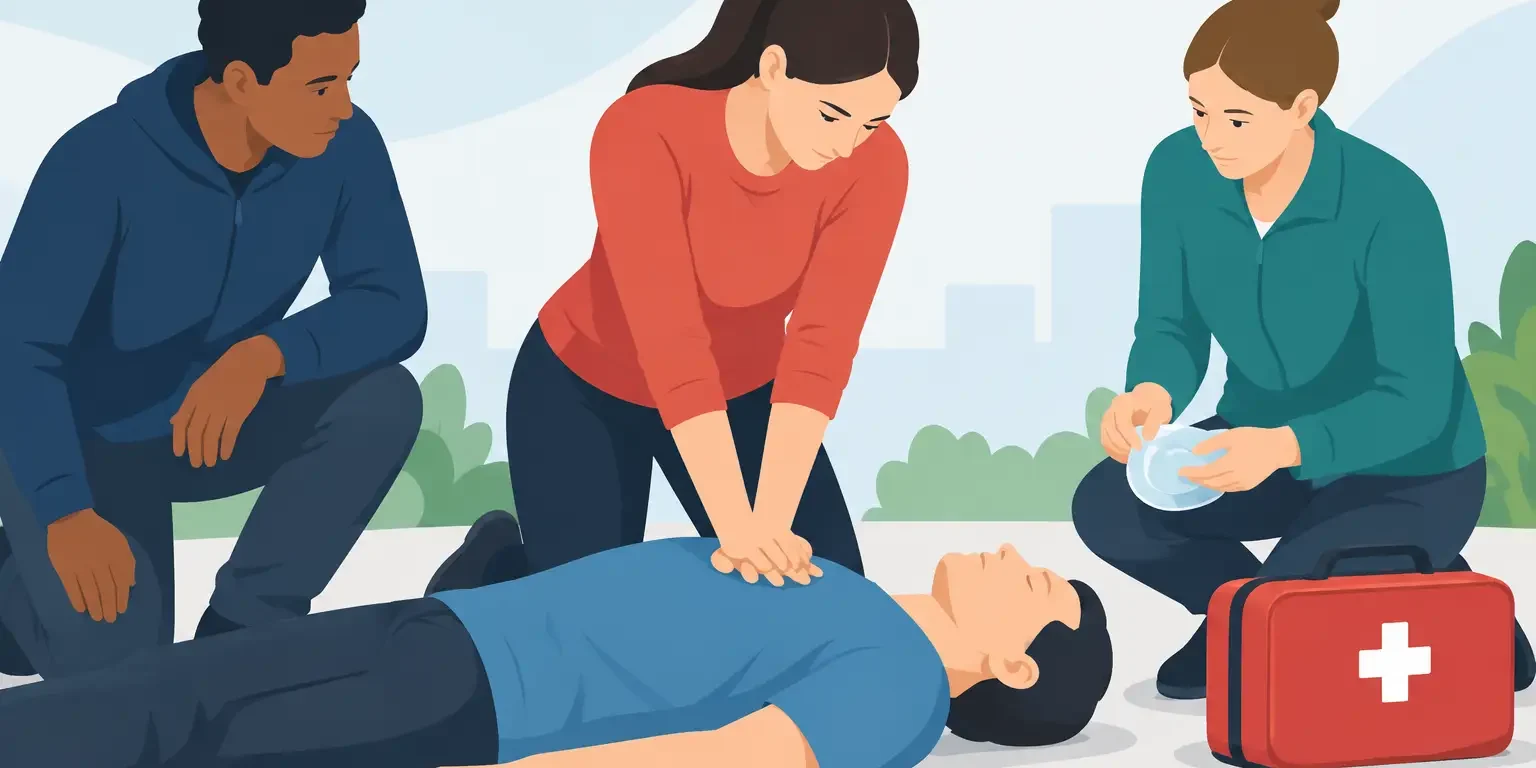
Sudden cardiac arrest is not the same as a heart attack, although a heart attack can sometimes lead to cardiac arrest. When a person is unresponsive and not breathing normally, immediate CPR and rapid AED use can make a critical difference while waiting for EMS.
High-quality CPR requires practice. Students need to learn hand placement, compression depth and rate, full chest recoil, and how to limit interruptions. An AED is designed to guide a lay rescuer with voice and visual prompts, but familiarity reduces hesitation. The device analyzes the heart rhythm and will not advise a shock unless it identifies a shockable rhythm.
Training also teaches responders when not to move a patient, how to work around wet environments or medication patches, and how to continue care when multiple people are available. These details are why a hands-on class is more valuable than simply watching a video.
Severe Bleeding
Bleeding control is another skill where fast, focused action matters. For serious external bleeding, apply firm, continuous pressure directly over the wound using gauze, cloth, or other available material. If the bleeding is life-threatening and direct pressure is not enough, a commercial tourniquet may be appropriate when the responder has been trained in its use. Record the time it was applied and do not remove it unless directed by qualified medical personnel.
Not every cut requires an emergency response. Small wounds may be managed with cleaning, pressure, and a bandage. Deep wounds, uncontrolled bleeding, wounds with embedded objects, and injuries involving significant force deserve professional assessment. Do not pull out an embedded object. Stabilize it as best as possible and call for help.
Choking, Allergic Reactions, and Medical Emergencies
A person who can cough or speak may still be moving air. Encourage them to continue coughing and watch closely. A person who cannot speak, cough, or breathe needs immediate action according to current choking-response training. If they become unresponsive, activate 911, begin CPR, and use an AED as directed.
Severe allergic reactions can worsen quickly. Trouble breathing, swelling of the face or throat, widespread hives, weakness, or collapse after an exposure are warning signs that require emergency care. If the patient has a prescribed epinephrine auto-injector and is able to use it, encourage its use. A trained responder may be able to assist under the guidance provided in their course and local protocols. Even when symptoms improve, the patient needs emergency evaluation.
For possible stroke, remember that sudden facial droop, arm weakness, speech difficulty, confusion, loss of balance, or severe unexplained headache are reasons to call 911 immediately. Note when the person was last known to be well. For diabetic emergencies, seizures, breathing problems, and suspected overdose, the safest first step is similarly direct: call for help, protect the patient from additional injury, and provide only the care you are trained to give.
Good First Aid Means Knowing Your Limits
The strongest responders do not try to perform procedures beyond their education. They avoid giving medications that are not prescribed for the patient, do not offer food or drink to a person with altered consciousness, and do not move someone with a possible neck, back, or major trauma injury unless immediate danger makes staying put unsafe.
They also understand that an alert patient can still be seriously ill. Pale skin, sweating, confusion, worsening pain, difficulty breathing, repeated vomiting, or a change in level of consciousness should never be dismissed because the patient is still talking.
First aid training builds a framework, not a license to practice medicine. EMT education goes further into patient assessment, anatomy and physiology, airway care, trauma, medical emergencies, documentation, and team-based operations. For aspiring EMTs, a first aid and CPR course can be a useful foundation, but it is not a substitute for New York State EMT certification training.
Why Hands-On Training Builds Better Responders
Reading about CPR is different from delivering effective compressions on a manikin. Watching a bleeding-control demonstration is different from applying pressure while an instructor corrects your technique. In a classroom setting, students can ask questions, practice communication, work through realistic scenarios, and receive feedback before they face a real emergency.
That practice also develops composure. The first few seconds of an incident can feel chaotic, particularly when the patient is a family member, coworker, or child. Repetition gives a responder a reliable starting point: check safety, call for help, assess breathing, address the immediate threat, and continue to monitor.
At TIMER, first aid and CPR instruction is part of a broader commitment to practical emergency education led by experienced medical and emergency-response professionals. For students considering a future in EMS, that environment helps connect basic lifesaving skills to the professional standards expected in patient care.
Turn Preparedness Into a Habit
A class is the beginning, not the finish line. Keep your certification current, replace expired supplies, know where AEDs are located at work or school, and review emergency plans with your household. If you carry a first aid kit, make sure you know what is in it and how to use it.
Most people hope they will never need these skills. But when an emergency happens, preparation gives you something more useful than a perfect script: the ability to take the next right step while help is on the way.