A person who suddenly collapses, does not respond, and is not breathing normally may be in cardiac arrest. In that moment, knowing how to use AED equipment can help you act with purpose while emergency responders are on the way. An automated external defibrillator, or AED, is designed to analyze the heart’s rhythm and, when appropriate, deliver a shock that may help restore an effective rhythm.
AEDs are placed in airports, schools, gyms, offices, apartment buildings, and public venues for a reason: they can be used by trained responders and bystanders alike. The device gives spoken instructions, but it does not replace the need to call 911, begin CPR, and maintain a safe scene.
Recognize Cardiac Arrest and Start the Response
Cardiac arrest is not the same as a heart attack. A heart attack is caused by a blockage that reduces blood flow to heart muscle. Cardiac arrest occurs when the heart stops pumping blood effectively. A person in cardiac arrest may collapse without warning, be unresponsive, and have no normal breathing. Occasional gasping is not normal breathing.
First, make sure the area is safe for you, the patient, and others nearby. Check for responsiveness by speaking loudly and tapping the person. If there is no response and no normal breathing, direct someone to call 911 and get an AED. If you are alone, call 911 on speaker if possible so you can begin care without leaving the patient. If an AED is immediately available, use it as soon as possible.
Begin high-quality CPR while the AED is being retrieved. Place the heel of one hand in the center of the chest, place the other hand on top, and compress hard and fast at a rate of 100 to 120 compressions per minute. For an adult, compress at least 2 inches deep and allow the chest to fully recoil between compressions. If you are trained and willing to give rescue breaths, provide 30 compressions followed by 2 breaths. If not, hands-only CPR is far better than waiting to do nothing.
How to Use an AED Step by Step
AEDs vary slightly by manufacturer, but their prompts follow the same basic sequence. As soon as the device arrives, turn it on and follow its instructions. Continue CPR until the machine tells you to stop.
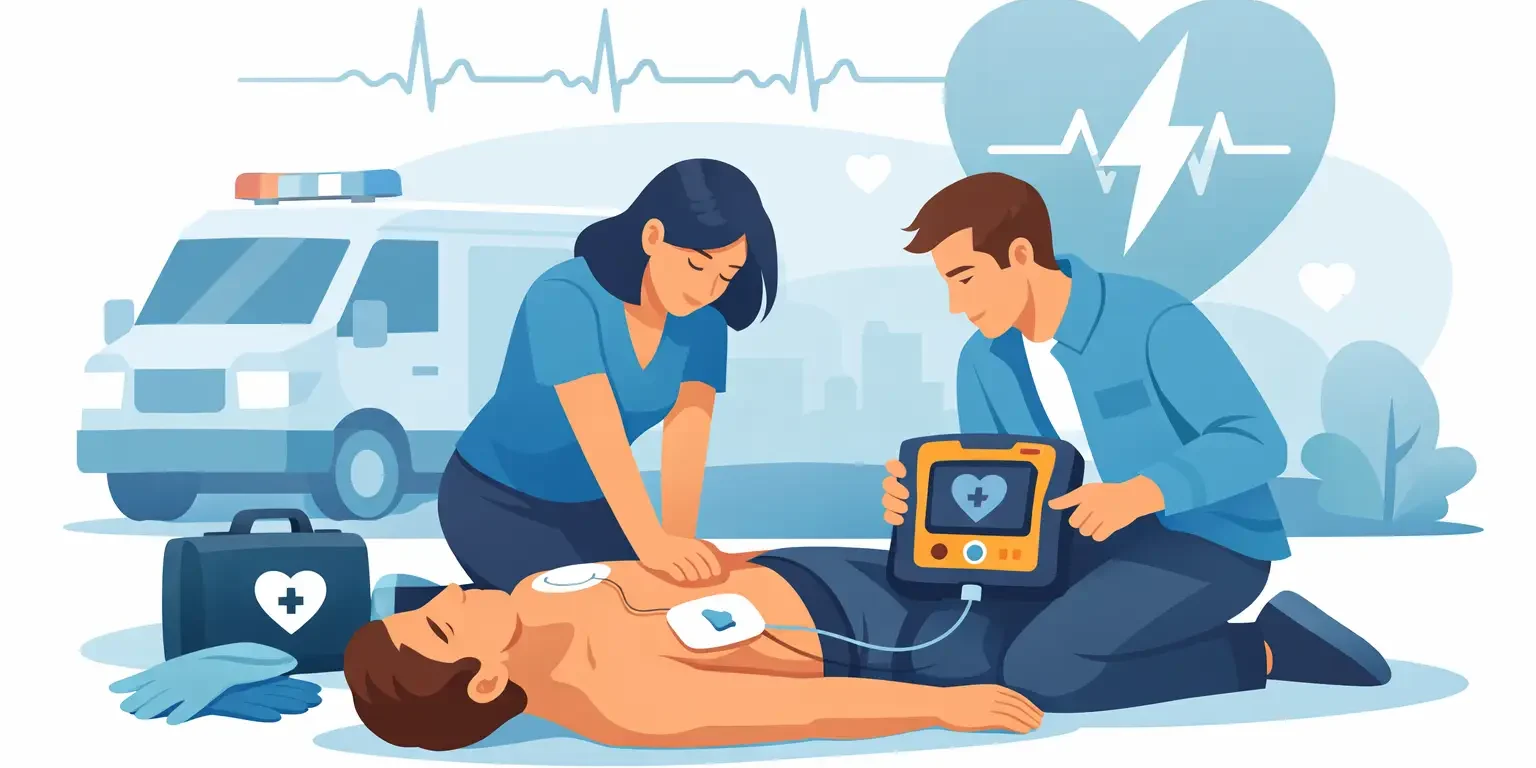
- Turn on the AED. Open the lid or press the power button. Many units begin speaking as soon as they are opened. Listen closely and follow each prompt.
- Expose and prepare the chest. Remove clothing from the patient’s chest. It must be bare and reasonably dry so the pads can adhere. Quickly wipe away water, sweat, or excessive moisture. If chest hair prevents a pad from sticking, use the razor included in many AED kits to shave only the pad area, then apply a new pad.
- Apply the pads as shown. Open the pad package and use the picture printed on the pads as your guide. For most adults, place one pad on the upper right chest, below the collarbone, and the other on the lower left side of the chest, below the armpit. Press firmly to make full contact with the skin.
- Clear the patient for analysis. Once the pads are connected, the AED will analyze the heart rhythm. Stop CPR and make sure no one is touching the patient. Clearly say, “Clear,” and visually check that everyone is away. Even light contact can interfere with rhythm analysis.
- Deliver a shock only if the AED advises it. If the device says a shock is advised, make certain no one is touching the patient, then press the flashing shock button if directed. Some newer AEDs deliver the shock automatically after warning rescuers to stand clear. Immediately resume CPR after the shock, beginning with chest compressions. If no shock is advised, resume CPR right away as instructed.
The AED will typically reassess the rhythm after about two minutes of CPR. Continue this cycle – CPR, analysis, shock if advised, and immediate CPR – until the person begins to show clear signs of life, another trained responder takes over, or EMS personnel arrive and direct you to stop.
Pad Placement and Common Real-World Problems
In a classroom scenario, the chest is dry, the pads stick perfectly, and there is room for everyone to work. Real emergencies are less orderly. The important point is to solve problems quickly without allowing them to delay CPR for long.
If the patient is wet, move them away from standing water if it is safe to do so and dry the chest before attaching pads. Do not use an AED in a puddle or where rescuers could be exposed to an electrical hazard. Rain alone does not mean you should abandon care, but a dry chest and safe working area matter.
If you see a medication patch where a pad needs to go, remove the patch with a gloved hand or other barrier, wipe the area clean, and place the pad away from that location. If the person has a visible pacemaker or implanted defibrillator, often seen as a small raised lump below the collarbone, do not place a pad directly over it. Position the pad at least one inch away.
For infants and children, use pediatric AED pads or a pediatric setting when available. These reduce the energy level delivered. If pediatric pads are not available, an adult AED may still be used for a child in cardiac arrest. Follow the AED’s instructions and make sure the pads do not touch each other. For a small child or infant, one pad may be placed on the chest and the other on the back if needed to prevent overlap.
Do not remove AED pads just because the patient moves slightly or makes an occasional gasp. Follow the device prompts, assess the situation, and wait for EMS. A person who becomes responsive and begins breathing normally should be monitored closely until help arrives.
Safety Rules That Cannot Be Skipped
An AED is built with safeguards, but the rescuer remains responsible for keeping everyone clear during analysis and shock delivery. Never touch the patient when the AED is analyzing or delivering a shock. Make a clear verbal announcement and look before pressing the button.
Keep oxygen sources away from the chest during a shock. If oxygen is being used by a trained responder, move the delivery device away from the patient’s chest according to local protocol. Also avoid placing pads over conductive jewelry if it interferes with pad contact, although you should not spend valuable time removing jewelry that is not in the way.
Most AEDs will not shock unless they detect a rhythm the device identifies as shockable. That feature is helpful, but it should never make a bystander hesitate to apply the AED. Put the pads on, let the device analyze, and resume CPR when instructed.
Training Builds Speed When Seconds Matter
Reading the steps is a useful start, but hands-on practice changes how people respond under pressure. In an emergency, a trained person is more likely to recognize abnormal breathing, assign tasks clearly, begin effective compressions, and use the AED without losing time to uncertainty.
For aspiring EMTs, firefighters, healthcare workers, and community responders, CPR and AED skills are foundational patient-care skills. They also reinforce a larger professional habit: assess the scene, identify the immediate threat to life, use available resources, and communicate effectively with the arriving EMS crew. At TIMER, practical emergency education is built around that kind of real-world decision-making, not just memorizing a sequence for an exam.
If you work in a school, gym, office, or public-facing setting, take a moment before an emergency occurs to locate the AED, learn who maintains it, and understand your organization’s response plan. A device that cannot be found, has expired pads, or is locked away from the public will not help when it is needed.
The most helpful action is rarely perfect action. Call 911, start CPR, bring the AED to the patient’s side, and let the device guide the next step. Preparedness gives you the ability to help when another person has no time to spare.