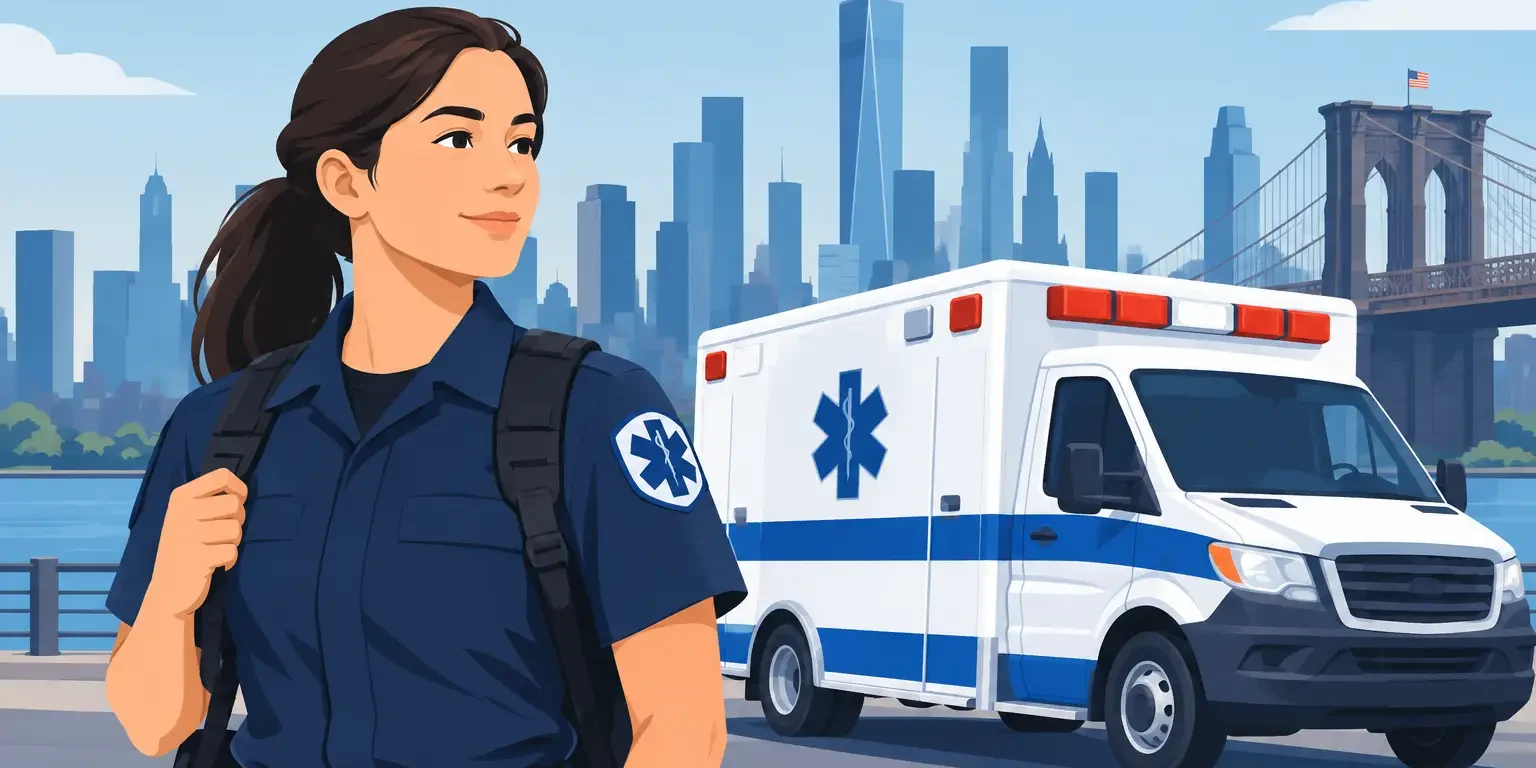
An ambulance career in New York begins long before the first emergency call. It starts with the ability to stay composed, communicate clearly, learn medical skills thoroughly, and show up prepared for a team that depends on you. This New York ambulance career guide explains the route from interested student to entry-level EMT, along with the decisions that can shape where you work and how you grow.
For many Staten Island and New York City residents, EMT certification is a direct entry point into healthcare, public safety, and community service. It can also be a strong foundation for future work in nursing, firefighting, paramedicine, hospital care, and other clinical roles. The work is demanding, but it gives dedicated people the chance to make a practical difference when patients and families need help most.
What Ambulance Work Looks Like in New York
EMTs provide emergency medical care under New York State protocols and within their certification level. On an ambulance, that can mean assessing a patient with chest pain, controlling bleeding after an injury, supporting breathing, taking vital signs, helping move a patient safely, documenting care, and communicating with receiving hospitals and other responders.
The public often associates ambulance work with high-acuity 911 calls. Those calls are part of the field, but they are not the whole job. Depending on the employer and assignment, an EMT may also transport patients between hospitals, nursing facilities, rehabilitation centers, medical appointments, or home. Interfacility transport can involve stable patients with ongoing medical needs, while 911 work may require rapid assessment in unpredictable environments.
Neither setting is automatically easier. A busy 911 system may bring trauma, cardiac emergencies, overdoses, psychiatric crises, and multi-agency scenes. Interfacility work requires attention to detail, patient comfort, safe transport, documentation, and professional communication over a full shift. The best starting point depends on the employer, your schedule, your confidence, and the type of experience you hope to gain.
Ambulance work is also team work. EMTs must communicate with partners, dispatchers, police officers, firefighters, nurses, physicians, and patients’ families. A strong EMT knows that technical ability matters, but so do reliability, situational awareness, respect, and the willingness to keep learning.
Your New York Ambulance Career Guide: The EMT Path
The first formal step is enrolling in an approved New York State EMT course. A basic course is not simply a test-prep class. It is where students build the patient-care habits needed to recognize emergencies, follow protocols, use equipment correctly, and make sound decisions under pressure.
Before applying, review current eligibility requirements carefully. Students generally need to meet New York State age and education standards, complete required coursework, and satisfy attendance and clinical or field requirements where applicable. Programs also expect students to participate actively in practical skills sessions, not just listen to lectures.
A quality EMT course combines classroom instruction with hands-on practice. You should expect to work through patient assessment, airway and breathing management, trauma care, medical emergencies, CPR-related skills, lifting and moving techniques, communication, and documentation. Practice scenarios matter because emergency calls do not arrive in textbook order. A patient may be frightened, a scene may be noisy, and information may be incomplete.
After successfully completing the course, candidates must meet the current New York State certification and examination requirements in effect at that time. Requirements can change, so students should confirm the process with their training provider and the appropriate state authorities before making career plans around a particular deadline.
At TIMER, students learn from active and experienced EMS, hospital, nursing, and emergency-response professionals who understand what field readiness requires. That local perspective can be especially valuable for students preparing to work in the New York City area, where communication, pace, and scene conditions can change quickly.
Training Is Where Confidence Is Earned
Many new students worry that they will not feel ready for their first call. That concern is normal. EMT education is designed to turn uncertainty into a repeatable process: assess the scene, protect yourself and your patient, identify immediate threats, gather information, provide care within your scope, communicate clearly, and reassess.
Confidence should not mean acting beyond your training. In EMS, professional confidence means knowing your role, asking for additional resources early, using protocols, and recognizing when a patient’s condition is changing. The best EMTs are not the loudest people on scene. They are often the most organized and attentive.
Choosing the Right First Ambulance Job
Once certified, applicants may find opportunities with private ambulance companies, hospital-based EMS systems, municipal services, volunteer organizations, special-event medical providers, and related healthcare employers. Availability varies by borough, agency, staffing needs, and the certifications an employer requires.
Pay, schedules, call types, benefits, and advancement opportunities can differ significantly. A position that offers more emergency-call exposure may involve overnight, weekend, or holiday shifts. An employer with a more predictable transport schedule may be a better fit for someone balancing school, family obligations, or another job. There is no single right answer, but applicants should ask clear questions before accepting a position.
Ask what type of calls the agency handles, whether new EMTs receive orientation or field training, how scheduling works, what equipment crews use, and what opportunities exist for advancement. If your goal is eventually to become a paramedic, firefighter, nurse, or physician assistant, look for an environment where you can build solid patient-contact experience and professional references.
Employers may also have requirements beyond EMT certification. These can include a driver’s license, driving record review, background screening, drug testing, immunization documentation, physical ability standards, and additional certifications such as CPR credentials. Read every job posting carefully. Being certified is essential, but being employable means meeting the full set of agency requirements.
Building Habits That Employers Notice
New EMTs are often hired for potential as much as prior experience. Employers understand that a newly certified provider is still learning the rhythm of the field. What distinguishes a promising applicant is preparation and professionalism.
Show up on time. Keep your certification documents organized. Practice introducing yourself to patients in a calm, respectful way. Learn how to receive feedback without becoming defensive. Review protocols and skills regularly, especially the areas that challenged you during class. These habits make a difference during interviews, orientation, and early shifts.
Physical readiness also deserves attention. Ambulance work can involve long hours standing, carrying equipment, assisting with patient movement, and working in poor weather or confined spaces. Proper body mechanics and teamwork protect both the patient and the crew. The goal is not to prove you can lift alone. The goal is to move patients safely and request help when needed.
Emotional readiness matters just as much. EMTs may encounter grief, violence, severe illness, substance-use emergencies, and patients facing difficult circumstances. Compassion is not a soft skill in this profession. It is part of effective patient care. At the same time, providers need healthy ways to process difficult calls, use peer support, and maintain boundaries outside of work.
Where an EMT Career Can Lead
Some EMTs build long-term careers in ambulance services and advance into supervisory, training, communications, or specialty roles. Others use EMT experience as a foundation for paramedic education, nursing school, fire service careers, emergency department work, law enforcement, or medical school preparation.
The credential alone does not guarantee a particular next step. Competitive career paths usually require academic performance, additional certifications, experience, and persistence. Still, EMT work offers something many entry-level healthcare roles cannot: direct experience assessing patients, operating as part of an emergency team, and seeing how medical decisions affect people in real time.
For students considering paramedic school, it is often helpful to first become comfortable with EMT fundamentals. Strong patient assessment, clear reports, dependable basic skills, and good judgment create a better base for advanced education. Rushing ahead without those habits can make the next level harder than it needs to be.
Start With the Standard You Want to Carry
An ambulance career asks for more than an interest in emergencies. It asks for discipline, humility, practical skill, and a commitment to treating every patient with dignity. Start with training that takes those responsibilities seriously, then bring the same standard to every class, exam, interview, and shift. The calls will be different each day, but preparation is the part you can control.